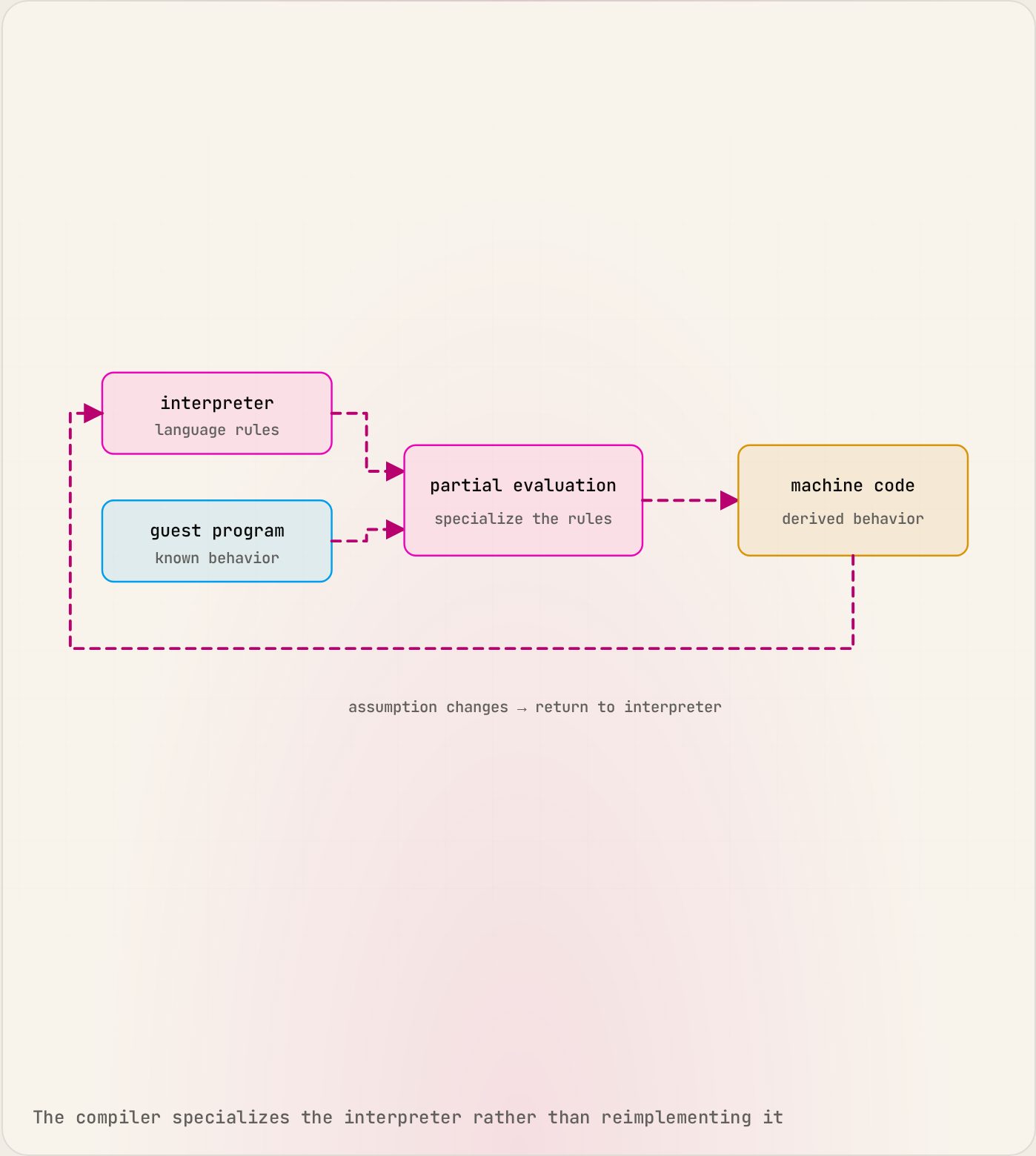
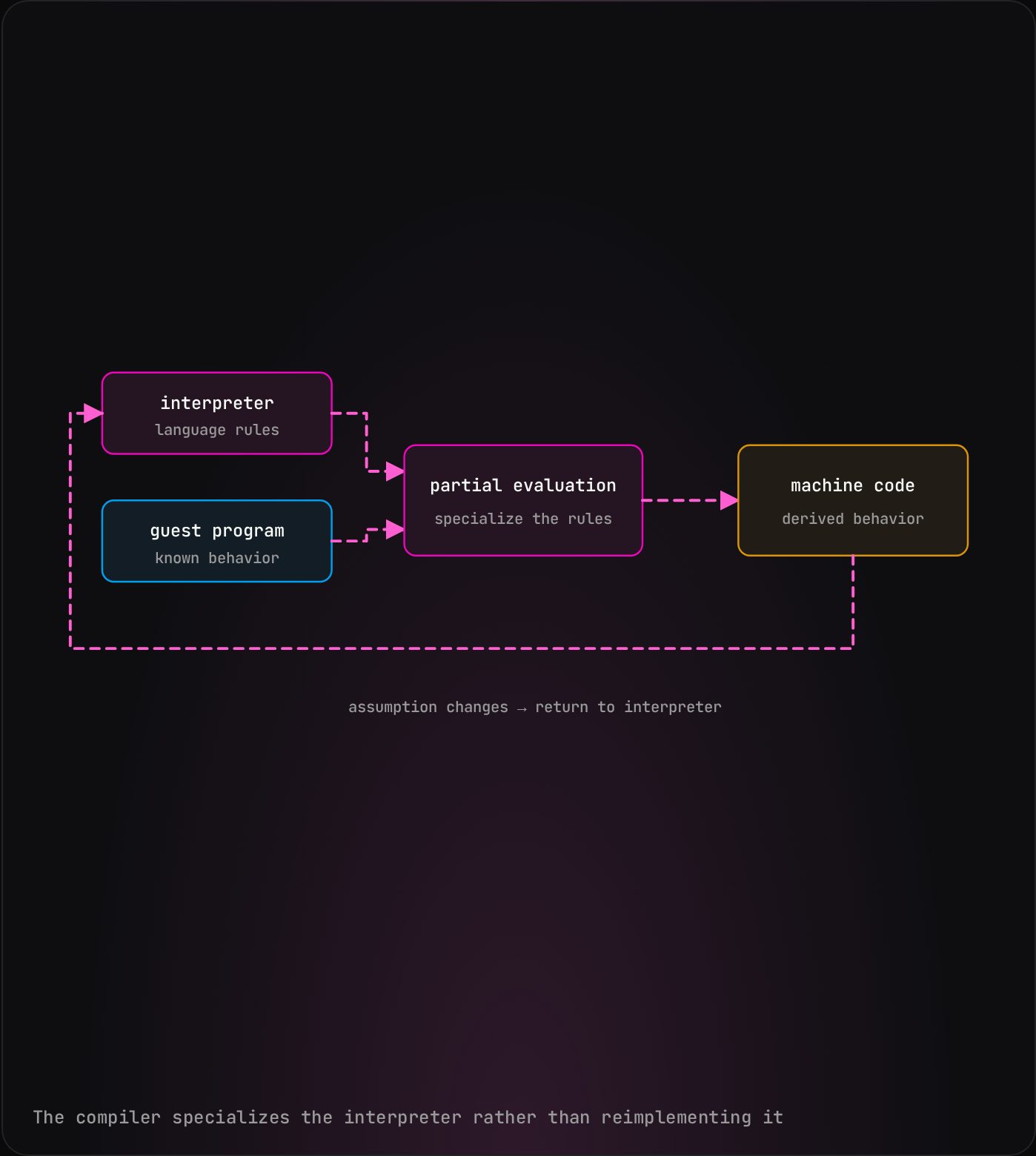
Elide carries memory-safety checks from the interpreter into optimized machine code. Guest languages share a foundation for safety and performance, and the compiler specializes that foundation for the code you run.[1]
One set of semantics, from interpreter to compiler
Truffle language implementations use managed objects, bounds checks and garbage collection. Graal specializes their interpreters into machine code, carrying the interpreter’s checked semantics through optimization. This reduces the need to maintain separate correctness rules in an interpreter and a guest-language optimizer.[1][2]
JavaScript, Python, JVM bytecode and WebAssembly implementations build on this common model. Language authors supply the semantics; Truffle and Graal provide the machinery that turns them into optimized execution.[1][2]
Precompile the engine, specialize guest execution
Native Image compiles reachable engine code ahead of time, packaging the runtime into a native executable. At runtime, Graal specializes guest execution using the behavior and values it observes.[3][4]
When an optimization’s assumptions change, execution can return to the interpreter and specialize again. The compiler must preserve language semantics throughout that process.[1][5]
This architecture puts the safety model and optimization strategy on the same foundation: the interpreter defines how the program behaves, and the compiler derives optimized execution from it.
Make native ownership explicit
Rust owns Elide’s native entrypoint and calls the managed engine through a C ABI. The interface defines pointer lifetimes, resource ownership and thread ownership at the boundary. Native libraries and extension interfaces use explicit ownership contracts to connect their resources to the runtime.[6]
That gives Elide a deliberate division of responsibility: managed semantics govern guest objects, while the native integration layer governs native resources.
Test native paths and reinforce their boundaries
Elide’s sanitizer builds exercise instrumented native paths to detect memory errors. Compiler and linker hardening reinforce the C integration.[7]
Together, checked guest semantics, compiler specialization and explicit native ownership let Elide pursue performance across its language stack while keeping memory safety central to execution.
Sources
- Writing Truly Memory Safe JIT Compilers — deriving optimized guest code from checked Truffle interpreter semantics.
- Truffle languages — language implementations on the shared framework.
- Native Image basics — reachability analysis and the native executable.
- Host compilation for Truffle interpreters — host compilation, guest compilation and partial evaluation.
- Optimizing Truffle interpreters — specialization and deoptimization.
- Elide’s native entrypoint — the engine call and native ownership boundary.
- Elide sanitizer configuration and native build configuration — native validation and hardening.